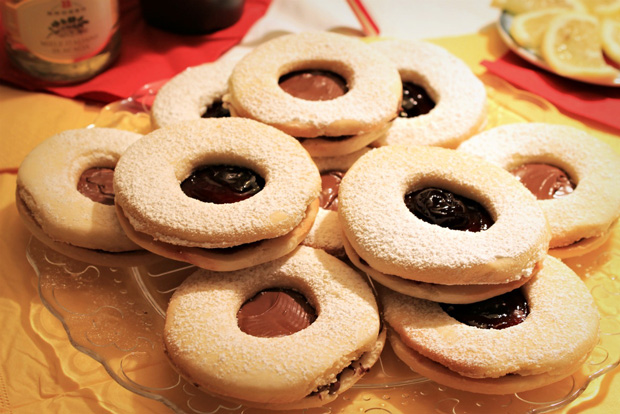
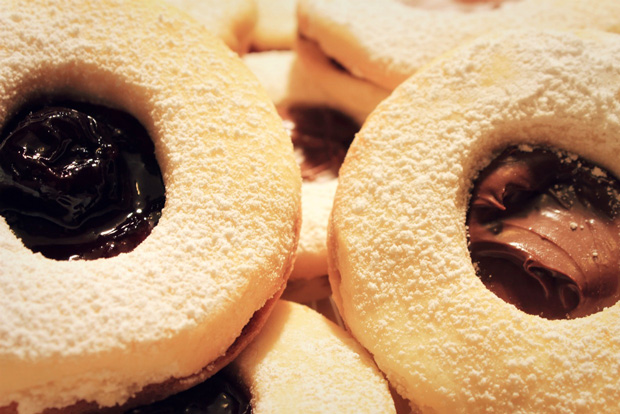
The only advantage of one of the few problems I have had with the Roman way of being is that they often made me feel like one of my favorite Star Trek characters: Data. I found it hard to understand when they were joking, or when they were angry, and I have had more than one awkward moment making a basic Catalan-style joke and finding that no one around me found it funny. For this very reason, the day I learned what these cookies were called, occhio di bue (ox eye), because of how the funny waiter of the moment told me, I thought he was pulling my leg. So I continued asking for them by saying “this round thing with jam in the middle,” until at another bar on the other side of Rome, they asked me if I meant an occhio di bue and I had to surrender to the evidence.
Unfortunately, this time I cannot inform you about the origin of this cookie, because it is not at all clear. I believe every European country has its own version of cookies similar to the occhio di bue, which they christen with whatever name they feel like. In fact, they remind me of the traffic lights I used to buy in Barcelona at Caelum. Here they call it ox eye, because of its shape and, by the way, there are those who also give this name to a fried egg, for the same reason. Like crostate, rather than as a dessert, it is eaten for breakfast, as a snack, or to accompany tea. In Rome you find them everywhere, although that does not mean their flavor is always the same, not by a long shot. Leaving aside the quality or the care with which they have been prepared, there is no standard recipe for preparing the dough. Of the ones I have tried, the one I will show you in this post is the one I like the most. I found it looking for one that was less dry and hard than the ones I knew, and the truth is that they turn out to be some delicious occhi di bue. The only drawback is that, once baked, they are a bit delicate. Do not fill them, nor touch them until they are completely cold, and even then, you have to handle them with great delicacy if you do not want them to crumble in the blink of an eye.
Contents
Visit my YouTube channel
If you haven't already, I invite you to subscribe to my YouTube channel so you don't miss any new recipes.Don't forget to follow me on Instagram! There I share more recipes, tips, and special content for Italian food lovers.
The latest video recipes from my channel!

The card
- 350 g pastry flour
- 150 g potato starch
- 1 egg
- Zest of half a lemon
- 200 g powdered sugar
- 1 teaspoon baking powder (Royal)
- 250 g butter
- 1 pinch of salt
- jam or Nutella to fill them.
- Form a volcano with the flour, potato starch, and baking powder.
- Add the butter cut into small pieces, the sugar, and a pinch of salt inside the volcano and start kneading.
- Add the egg and the lemon and continue kneading quickly until you obtain a homogeneous dough. If you have a food processor, put the ingredients inside the bowl and let it work for you until the dough is compact and there is no flour stuck to the sides of the container.
- Wrap the dough in plastic wrap and leave it in the fridge for half an hour.
- Turn on the oven to 170 degrees so it starts to heat up.
- Take the dough out of the fridge and the plastic and roll it out with a rolling pin until it is half a centimeter thick.
- Cut the bases of the occhi di bue with a glass or cookie cutter.
- Cut the same number of tops with the same cutter, plus another circle in the middle, cut with a cap or a smaller circular mold.
- Place the cookies on a sheet of parchment paper with which we have previously covered the baking tray.
- Bake the cookies for only 8 minutes. They will look raw, but they won't be. They should not brown.
- Take them out of the oven, but do not touch them until they are completely cold. The only drawback of these cookies is that they are a bit delicate. The hotter they are, the easier it is for them to break.
- Spread the base cookies with Nutella, jam, or whatever you like, but always delicately so they don't break.
- Sprinkle the tops of the occhi di bue with sifted sugar.
- Cover the jam-covered bases with the sugared tops.
- (If you want, you can cover the cookies and sprinkle them with sugar directly. I did it separately because I wanted the jam or Nutella inside the hole not to be covered by the sugar)