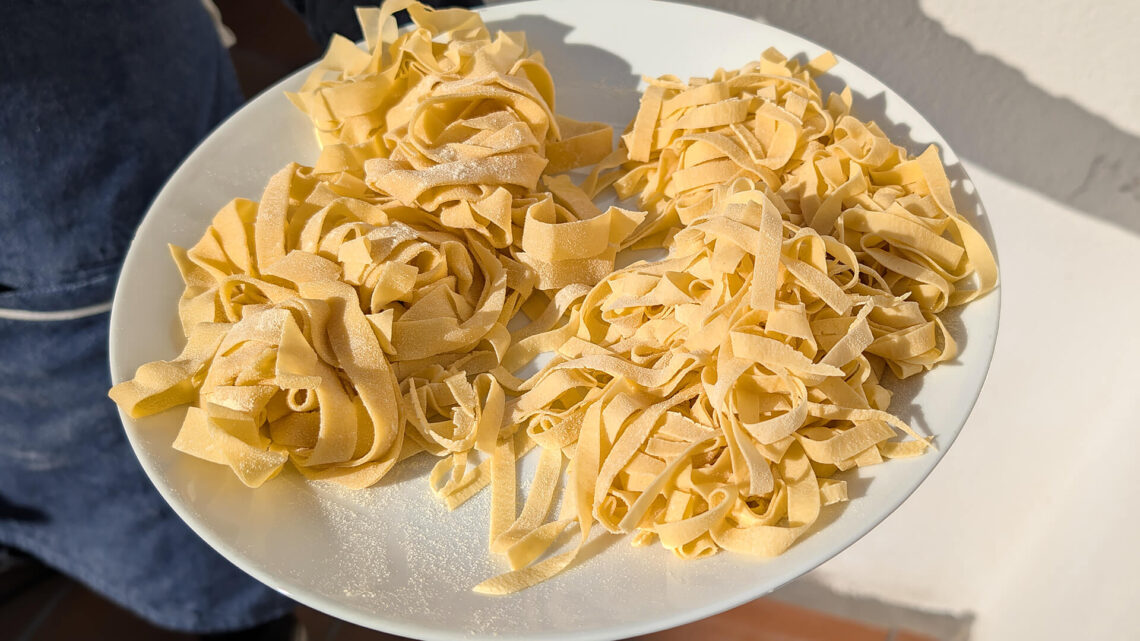
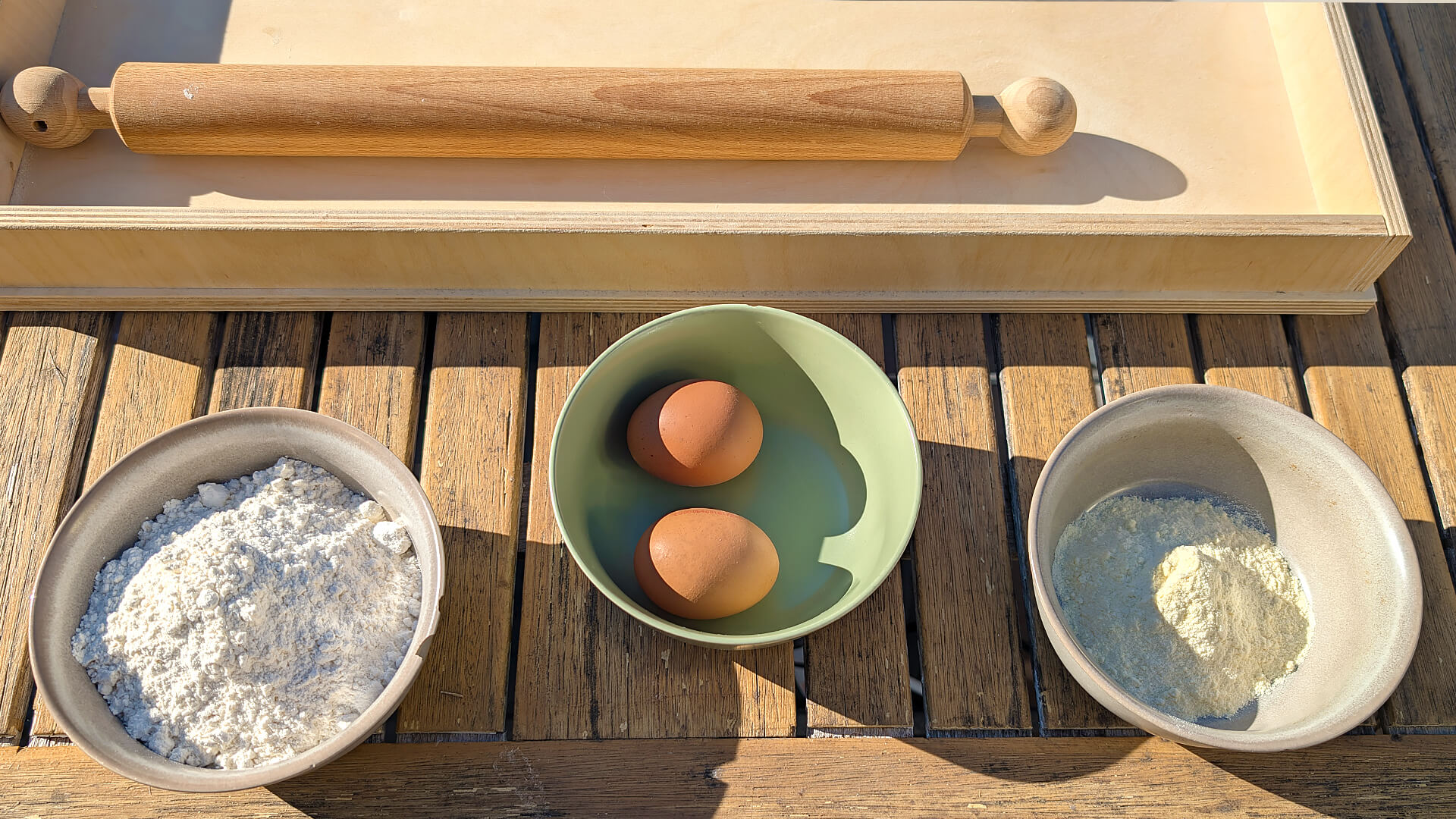
Making fresh egg pasta at home is very easy. Eggs, flour, and semolina (finely ground durum wheat semolina). The little machine for flattening and cutting it is tremendously useful if you want to give it the shape of tagliatelle, lasagna sheets, etc. What is semolina? Semolina is a type of extremely fine, re-milled durum wheat semolina, coarser than 00 wheat flour, but more delicate than common semolina. In Italy, it is mainly used to dust the surface during the preparation of fresh pasta. Its texture helps prevent the dough from sticking to the rolling pin, the machine, or between the already cut pasta sheets, in addition to providing a slightly rough finish that improves the adhesion of sauces to the cooked pasta.
With these basic ingredients, you will be able to prepare perfect egg pasta for any occasion. In this recipe, I will show you how to work the dough in the traditional style with the mattarello (rolling pin) and with the help of a pasta machine, allowing you to enjoy two different and authentic methods.
Get ready to enjoy an activity that is not only delicious but also a unique experience to connect with Italian tradition.
Contents
Curiosities about fresh egg pasta
Fresh pasta is a symbol of Italian cuisine and a tradition that many families carry out weekly, passing down recipes and techniques from generation to generation. There are two basic types: flour and water pasta, and egg pasta, the latter being the most popular in its fresh version in many countries.
In this recipe, we use semolina only to dust the surface during the kneading and cutting process. This step is key to preventing the dough from sticking to the rolling pin, the machine, or to itself, as well as providing a slightly rough texture that improves the adhesion of sauces to the cooked pasta. This practical and simple detail is part of the secrets of Italian tradition for achieving impeccable pasta.
Watch the video with all the steps
Below you can watch the video with all the steps to prepare the recipe in the easiest way.
If you haven’t done so yet, I invite you to subscribe to my YouTube channel so you don’t miss any new recipes.
Don’t forget to follow me on Instagram! There I share more recipes, tricks, and special content for lovers of Italian cuisine.

Necessary ingredients
For 2 people:
- 150 g all-purpose 00 flour
- 1 and 1/2 large eggs
- 20 g of semolina (optional for dusting)
Remember: At the end of the article, you will find the complete recipe card with detailed cooking and preparation times.
Step-by-step preparation of fresh egg pasta
Prepare the basic dough
Place the flour in a bowl and form a volcano in the center. Crack the eggs separately into a small bowl. This is more hygienic, as the eggs may have traces of dirt or shell that we do not want in the dough. Then, pour them into the well of the volcano. With a fork, mix the eggs with the flour little by little until a dough begins to form.
Once the mixture is consistent, transfer it to a work surface. You can use marble, but a wooden board is preferable, as it provides a texture that allows the pasta to better absorb the sauces.
Resting the dough
When the dough is smooth and elastic, wrap it in plastic and let it rest in the fridge for 30 minutes. This step is essential for the dough to relax and be easier to handle.
Stretching the dough with the mattarello
Place the dough on a wooden board dusted with semolina. Use the rolling pin to roll it out, turning it constantly to ensure it is uniform. Continue until you reach the desired thickness.
Using the pasta machine
If you prefer the machine, fix it well to the table. Pass the dough through the thickest setting several times, folding it between each pass. Gradually reduce the thickness by turning the dial until you obtain the fineness you need. Divide the sheet if it becomes too long to work with comfortably.
Cutting the pasta
Whether you use the rolling pin or the machine, dust semolina over the dough before cutting it. Form tagliatelle, fettuccine, or another format of your preference. Shake the pasta slightly to remove excess semolina before cooking it.

Tricks and tips for perfect fresh egg pasta
- Do not crack the eggs directly onto the flour: Always crack the eggs into a separate bowl to avoid hygiene issues.
- The texture of the dough: When the dough is ready, it should feel soft like the inner skin of your arm.
- Rest, but work: If you get tired before the dough reaches the perfect texture, you can let it rest in the fridge. Even so, it is important to knead it a little so it gains strength.
- Use re-milled durum wheat semolina: Dust lightly over the surface and the dough to prevent it from sticking while working.
- Thickness control: When stretching with the rolling pin or the machine, adjust the thickness according to the type of pasta you are going to prepare.
- Make folds: If you cut pasta like fettuccine or tagliatelle, fold the dough into pleats before cutting it. This makes the work easier and ensures a uniform cut.
Recipes you can prepare with fresh egg pasta
- Tagliatelle Bolognese: The classic that never fails.
- Fettuccine Alfredo: Creamy and comforting, ideal for any occasion.
- Tagliatelle with porcini mushrooms: With fresh sheets, the difference is abysmal.
Enjoy your homemade fresh egg pasta!
Making fresh egg pasta is a simple art that you can master with practice. With these steps and tips, you will not only create a delicious dish but also an unforgettable culinary experience.
If you liked this recipe, follow me on YouTube and Instagram to discover more authentic Italian recipes. Leave a comment telling me how it turned out and share your photos on social media. I would love to see your creations!
Bon appétit!
The latest video recipes from my channel!

The card
How to make fresh egg pasta: the original Italian recipe step by step.

Preparing fresh egg pasta at home is very easy. Eggs, flour and, if you want to give it a special touch, semolina.
Ingredients
- 150 g 00 all-purpose flour
- 1 and 1/2 large eggs
- 20 g of semolina optional for dusting
Instructions
- In a large bowl, place the flour forming a volcano with a well in the center.
- Crack the eggs separately into a bowl to ensure they are in good condition, then pour them into the well of the flour.
- With a fork, begin to mix the eggs with the flour, incorporating it little by little from the edges towards the center.
- When the mixture begins to thicken, transfer the dough to a flat surface, preferably wooden, to continue kneading.
- Knead with your hands using the base of your palm, folding the dough and turning it constantly. Work until you obtain a homogeneous texture that is elastic and smooth to the touch (similar to the inner skin of the arm).
- If the dough is too damp, incorporate a little more flour.
- Form a ball with the dough, wrap it in plastic wrap and let it rest in the fridge for 30 minutes.
- Once rested, divide the dough if you wish and roll out one part with a rolling pin (mattarello) and the other with a pasta machine.
- If using the machine, start with the thickest setting and pass the dough through several times, folding it between each pass, until you obtain a uniform sheet. Then progressively reduce the thickness using the thinner settings until you reach the desired thickness.
- For tagliatelle or other shapes, pass the sheets through the machine’s cutting roller or cut them by hand, dusting them with semolina to prevent them from sticking to each other.
Video